Barcelona Street Photography in Black and White
Barcelona street photography in black and white is a study in contrast — between old and new, stillness and motion, the ordinary and the unexpected. We have walked these streets across many seasons, cameras in hand, but there is something particular about stripping away colour that sharpens the focus on what matters most: light, shadow, and the people who move through it all.
This post collects images made across the city — from the Olympic Ring on Montjuïc to the narrow passages of the Barri Gòtic, from the white plaza of MACBA to the lit windows of Sant Pere at midnight. They were shot over different visits, in very different light, with both a Sony a7R IV and a Leica Q3. What connects them is not the camera or the hour. It is the city itself.
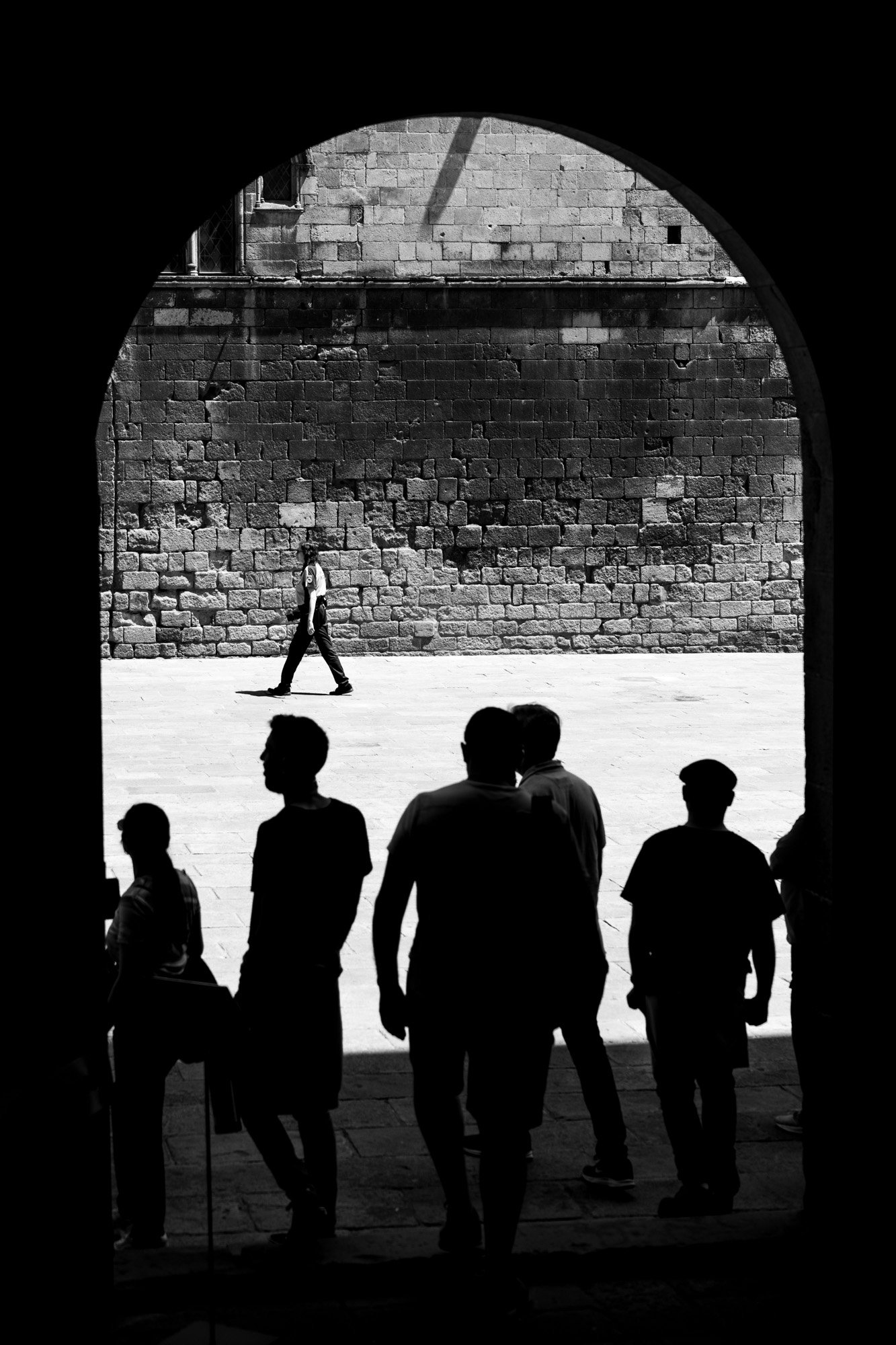
Beneath the arch — Barcelona
When Colour Steps Aside
A city as visually dense as Barcelona can be overwhelming in colour. Every facade competes with the next: the amber stone of the Gothic Quarter, the ochre render of the Eixample, the white geometric planes of Richard Meier's MACBA. In black and white, that competition disappears. What remains is geometry.
The arc of a doorway frames a figure mid-stride. A long shadow crosses an empty plaza at noon. A semicircular concrete ramp becomes a stage for a skater who stands still, board underfoot, looking sideways at something outside the frame — the tattoos across his bare back forming their own texture against a bleached wall. Strip the colour and the city becomes a collection of shapes asking to be read.
We shot the majority of these images with a Sony a7R IV, though a handful — the reflections series along the Passeig de Gràcia among them — were made with a Leica Q3. Both cameras handle high-contrast monochrome well, but the moment, not the gear, decides whether a frame works. Barcelona is generous with moments. The challenge is being in position when they arrive.
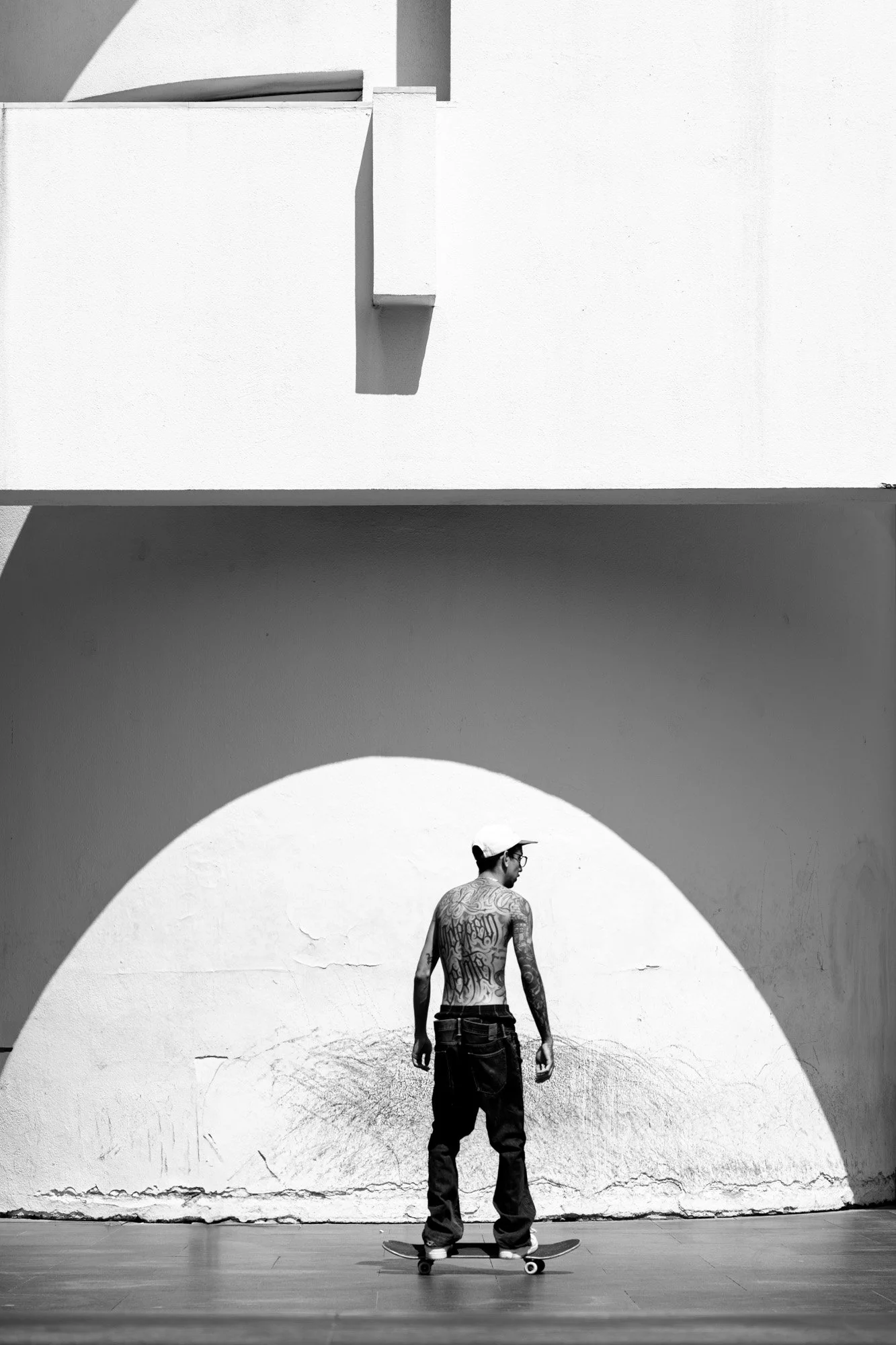
MACBA, Barcelona
Reading the Light in Barcelona Street Photography
Barcelona's midday light does not negotiate. In spring, it cuts hard shadows across stone sidewalks with surgical precision — shadows that are nearly as interesting as the subjects casting them. We have learned to use this light before it becomes too high and too flat, between nine in the morning and midday, when it comes in at an angle and creates depth out of flat surfaces.
From the elevated esplanade of the Olympic Ring — the complex that hosted the 1992 Summer Olympics and remains one of Barcelona's most undervisited open spaces — the wide plaza below becomes a near-abstract graphic problem. One man walks alone, his shadow twice his height on the pale herringbone paving. A second figure, smaller, crosses the same light at a different angle. Viewed from above, the image has more to do with geometry than with people.
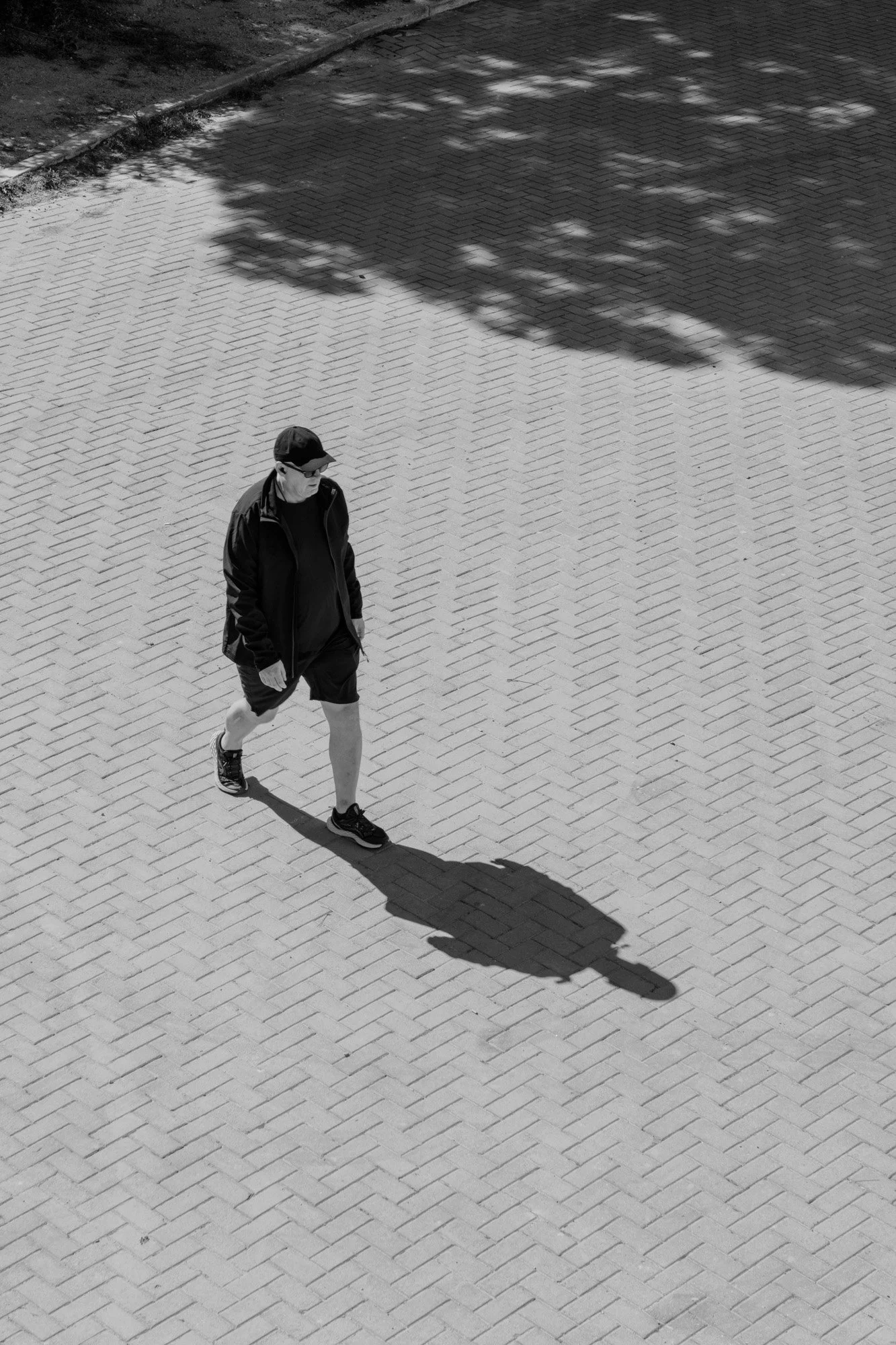
Olympic Ring, Montjuïc
From other elevated positions — the open terraces around MACBA, the streets of the Eixample, residential balconies over wider avenues — the city offers different registers. Three women stretch in synchrony on an open plaza, arms extended at identical angles, choreographed by no one. A girl on a balance bike crosses left-to-right in front of a modernist building's dark glazed facade, her frame small against the grid of black panels. A cyclist pulls a plaid shopping trolley with one hand, leaning forward into the quiet of early morning.
These photographs are not composed in the conventional sense. You choose your position, you set your exposure, and you wait. The composition arrives when someone walks into it.
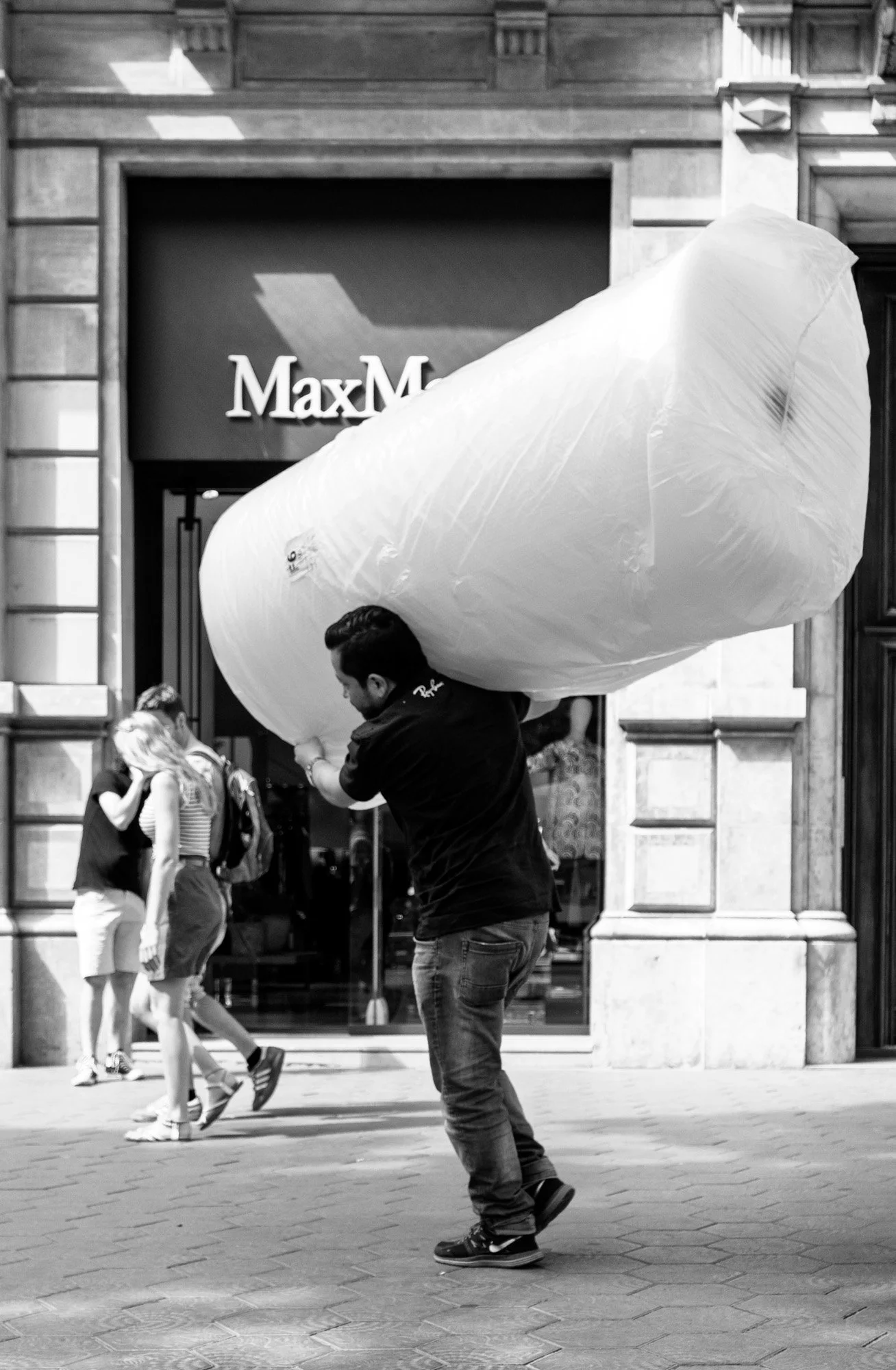
Passeig de Gràcia, Barcelona
Barcelona After Dark: Light as Character
After nightfall, the city rearranges itself without going quiet. The streets around Sant Pere Més Alt empty out without becoming deserted. A cheese shop stays lit long past the hour when the nearby bars have filled. Outside it, a white sphere lamp — a fixture that has hung in Barcelona's older neighbourhoods for generations — throws a clean ring of light against stone, the street sign legible in the upper left corner, two people at the door considering what's in the window. A bicycle leans against the wall. Nobody is in a hurry.
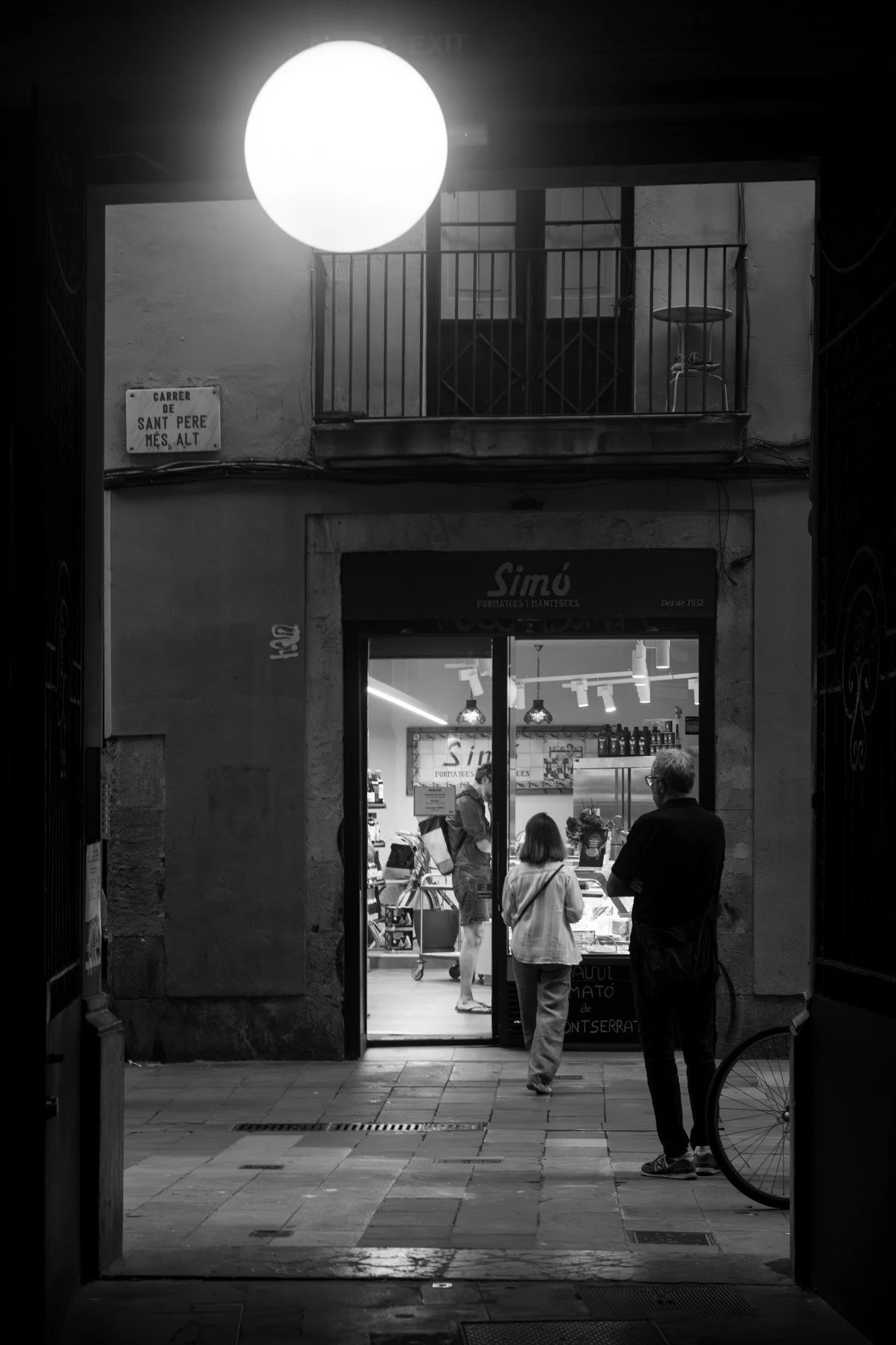
Sant Pere Més Alt, Barcelona
Further into the Gothic Quarter, the covered passage that runs between old city walls and a low arcade becomes a corridor of near-total darkness, with the arch at the far end opening onto a lit courtyard beyond. A couple moved through this passage while we watched — his silhouette broad and solid, her dress scattering the ambient light like slow sparks. We had one second, and it was enough. The Gothic Quarter rewards this kind of patience. For more from the neighbourhood at this hour, our Barcelona Gothic Quarter street photography post explores the medieval geometry in detail.
The series continues into concrete and glass in Barcelona Modern Architecture, the third chapter of this project.
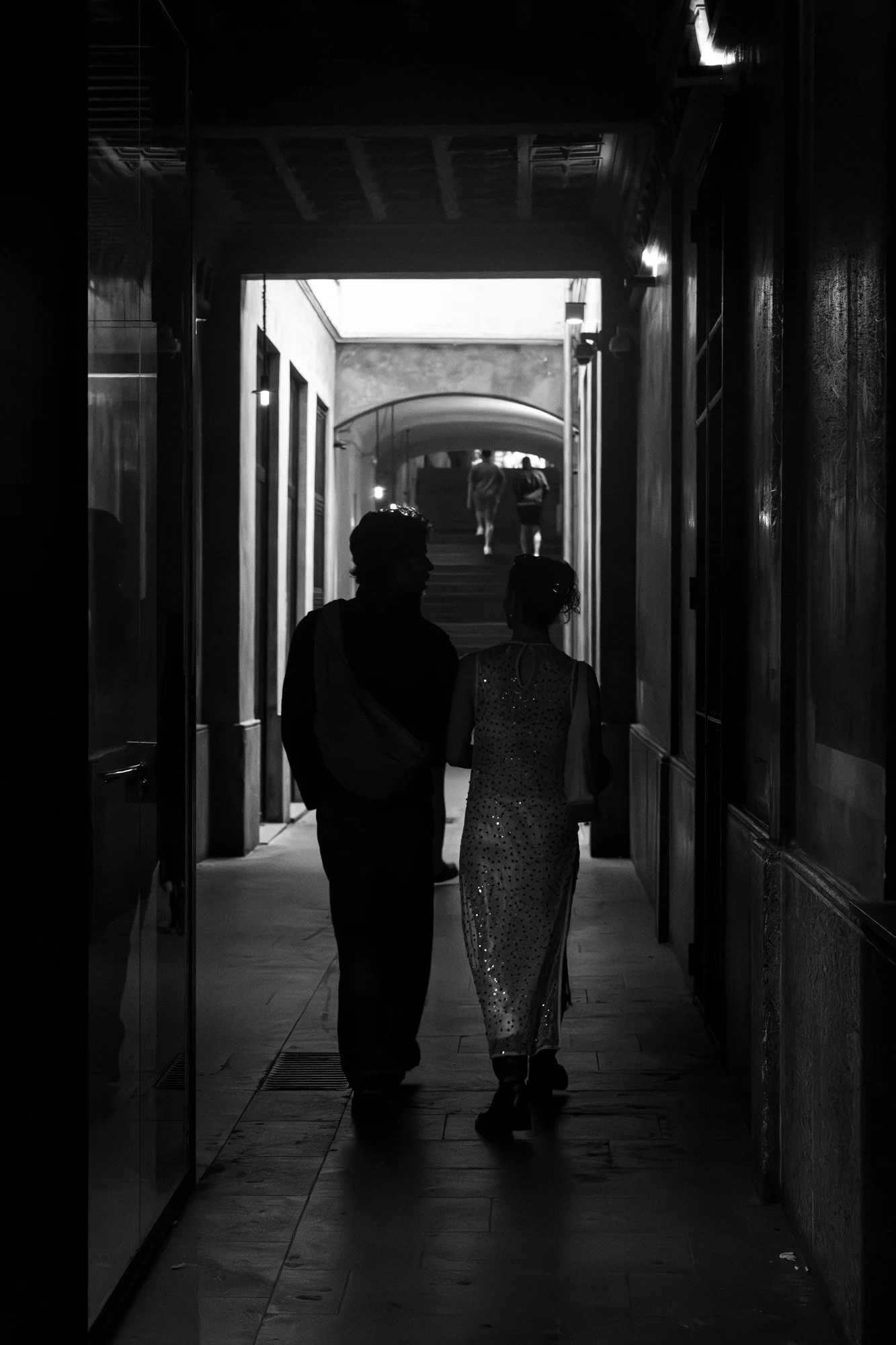
A passageway in the Gothic Quarter, Barcelona
Between the Iconic and the Unplanned
Not every photograph in this series is the result of patience. Some arrive because you happen to be standing in the right place at a moment no one could have arranged.
At the entrance of the MACBA, a father and son stood outside a design shop window displaying table lamps — white ceramic dome heads on slender metal rods. Through the glass, in the reflection, the lamps appeared to sit directly on their shoulders. The boy stared straight ahead, oblivious. The father looked elsewhere. The lamps, in their way, smiled at both of them. You cannot plan that. You can only be ready to press the shutter when it happens.
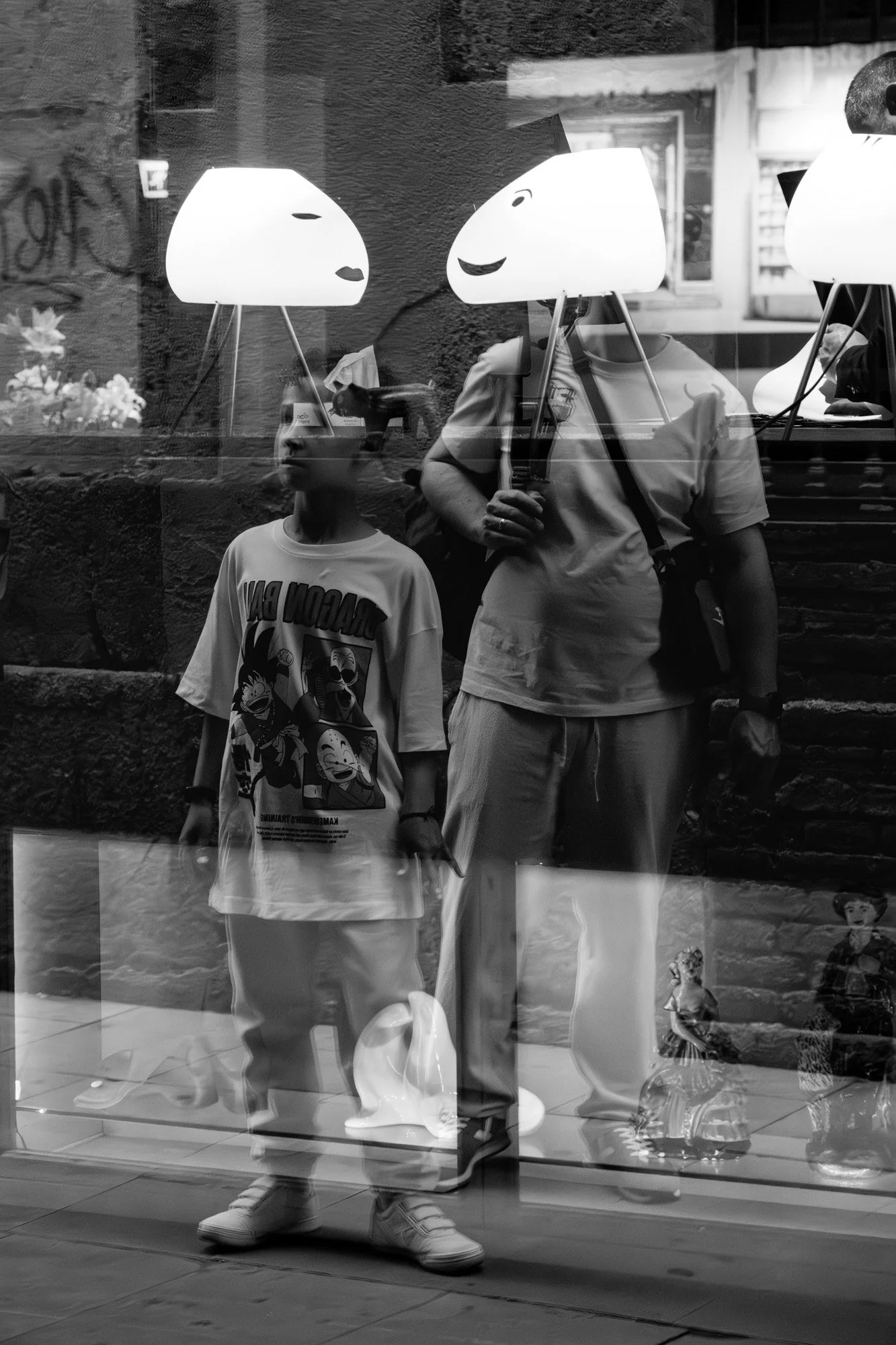
MACBA design shop, Barcelona
On the Passeig de Gràcia, one of Barcelona's main commercial thoroughfares, a couple walked quickly past a shop window. In the glass, they doubled: the real pair sharp in the foreground, their reflections dissolving into the trees and facades of the boulevard behind them. The Passeig is so layered — the organic curves of Casa Milà visible in one direction, the strict Eixample grid in the other — that even a simple window becomes a composition.
These are the frames that keep us returning to these streets. Not the predictable compositions, though they have their place, but the one that assembles itself in under a second and is gone before you can fully name what made it work.
If you find yourself in Barcelona, give yourself at least one morning — camera or no camera — to walk from the MACBA toward the Barri Gòtic before ten o'clock. The light, and what it does to the people moving through it, is worth the early start.
For the same streets under a different light, see our Barcelona in full summer post — this project in colour and heat rather than black and white.
Photos: Sony a7R IV and Leica Q3
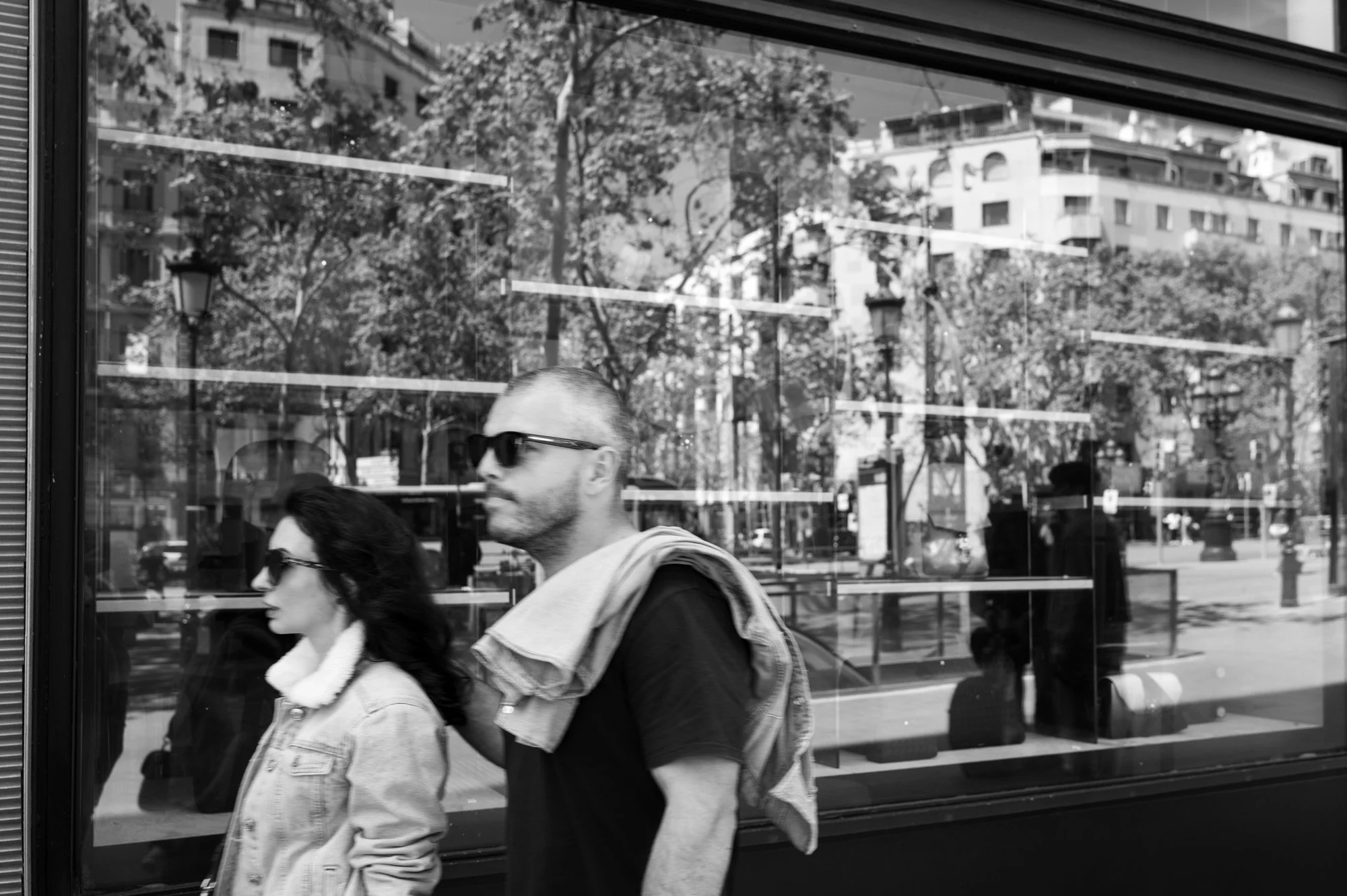
Passeig de Gràcia, Barcelona
See more street photography from Barcelona in the portfolio.
Want one of these on your wall?
Every photo on this site can be printed — archival paper, signed and numbered. Browse prints →
Cosme Lapena is a Barcelona-based street and urban photographer and founder of bCLPhoto. Browse the portfolio or read more on the blog.